EngineeringLive2026
Edgeways
A matched-betting command centre with paying users that tells you whether an offer actually paid.
Live with paying subscribers; six versions shipped in eight weeks.
Live at edgeways.app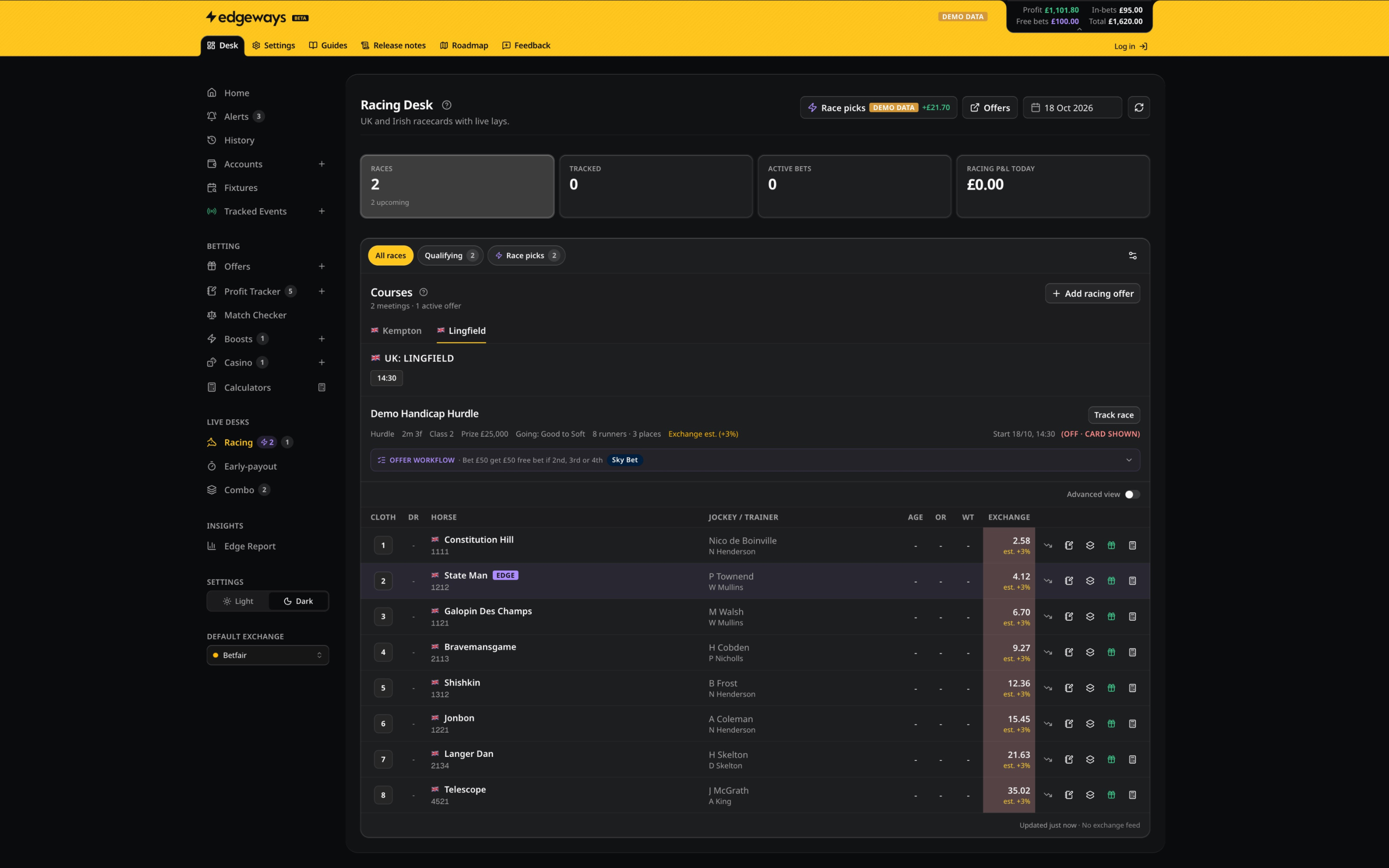
TL;DR
01 / What it is
A matched-betting command centre I built and run solo. It tracks every offer from placement to settlement and tells you whether it actually paid.
02 / Why it existed
The incumbents help you find offers. Nobody helped you execute them well, or told you what you really made. That was the gap.
03 / What I achieved
Live with paying subscribers, six versions in eight weeks, and the proving ground for how I build with AI.
- versions shipped in 8 weeks
- 6
- subscribers
- paying
Overview
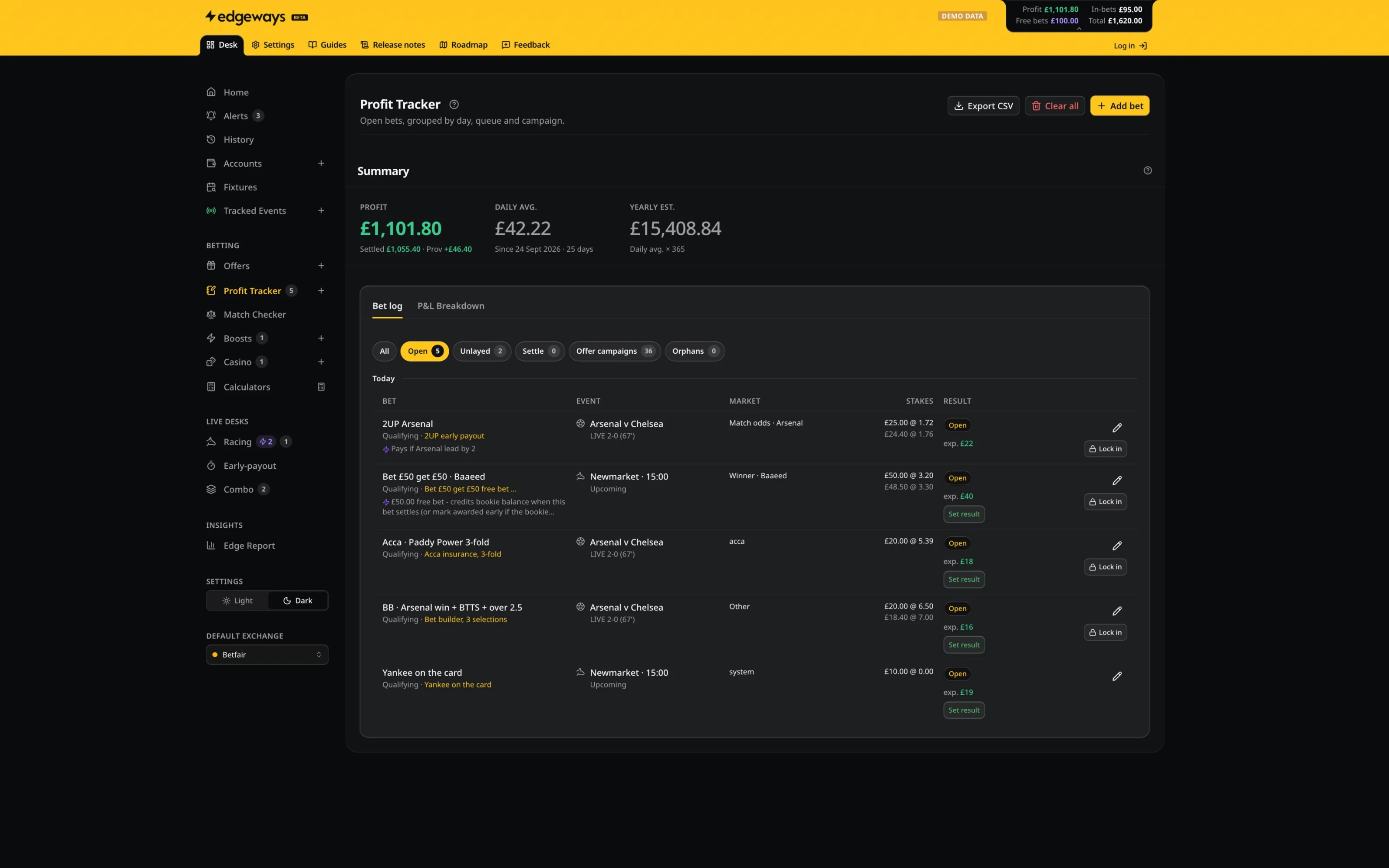
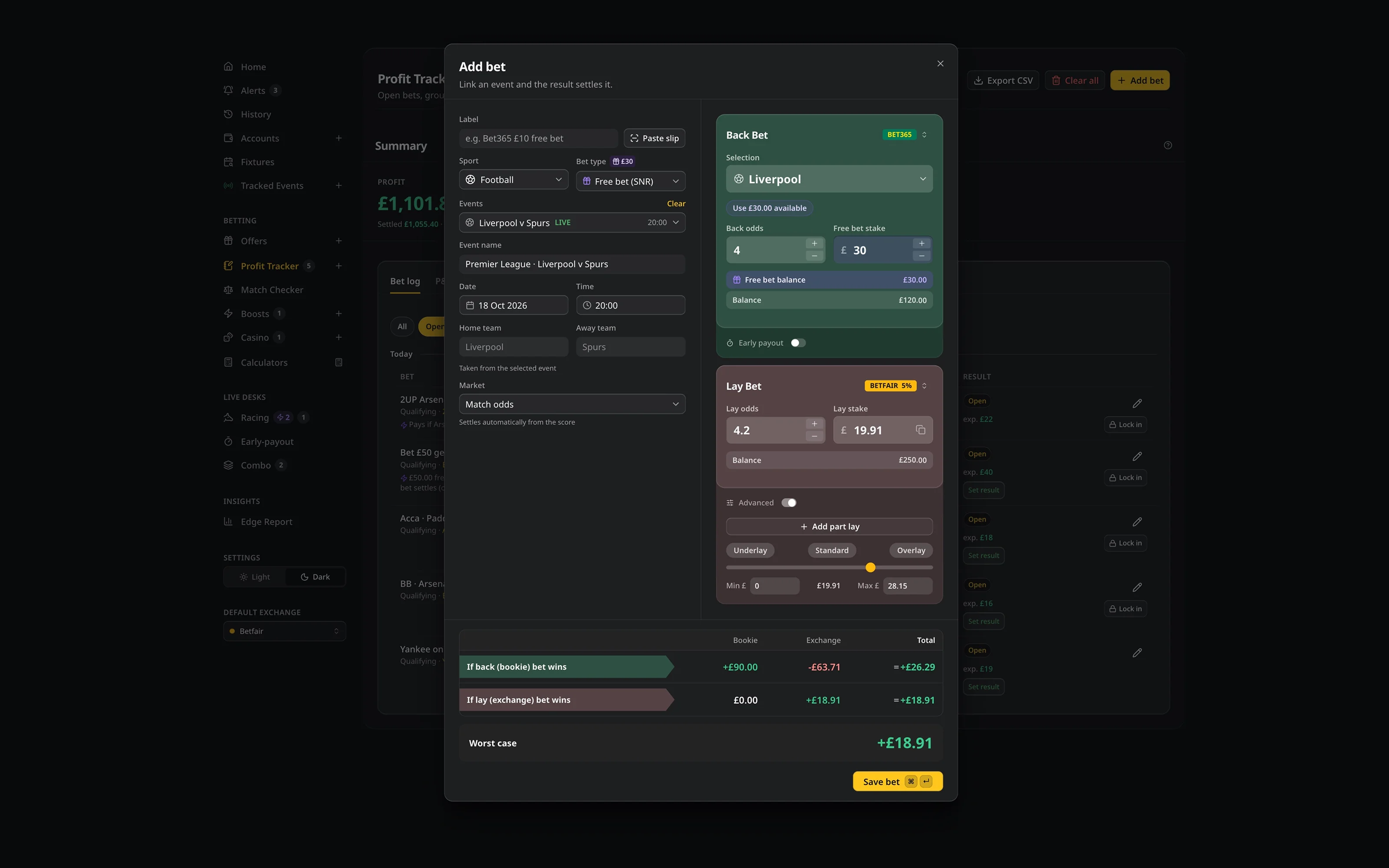
Edgeways is a web app for matched betting: turning bookmaker free bets into guaranteed profit by backing with the bookmaker and laying the same outcome on an exchange. OddsMonkey, Outplayed and the rest are good at finding offers. Edgeways is about executing them. It logs each offer, matches the back and lay, settles the result and keeps a running profit per hour, so you always know what an offer really made after fees.
Why it existed
Matched betting is money-sensitive and time-sensitive. An offer expires, odds move, and you have seconds to decide. The existing tools stop at discovery: they do not check that your lay matched, that the settlement was right, or that the offer made money after fees. I wanted that part solved. Edgeways is also where my AI build setup earns its keep: Loop dispatches the agents and review agents gate every change.
My role
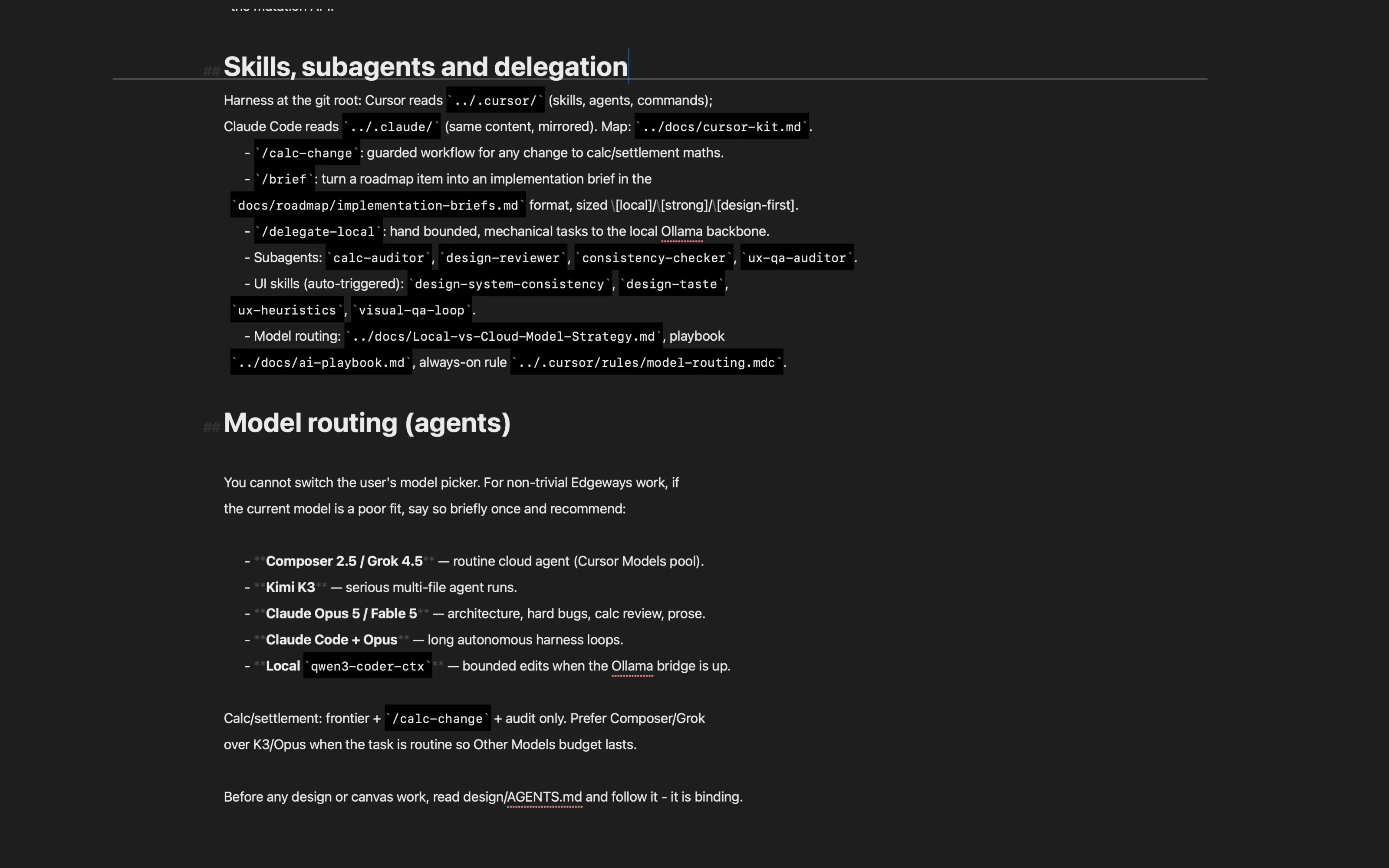
Everything, solo: product strategy, UX and UI, the design system, full-stack engineering and operations. I build with AI, gated by two review agents I wrote, one that audits the money maths and one that checks the UI against the design system. Every change goes through Loop.
Approach
Engineering
Engineering
The stack is Next.js, TypeScript, Supabase for the database and auth, Stripe for subscriptions and Vercel. The architecture is straightforward; the hard part is the money maths. The calculation engine settles every bet and, for football, prices outcomes with the Dixon-Coles model, a statistical method for estimating match probabilities. The rule is strict: AI may draft a calculation change, but a dedicated audit agent must pass it before it ships.
AI-assisted development is used throughout - this is the proving ground for Loop. Agents build in isolated copies of the codebase, open pull requests, and the review agents run before merge. Where AI sped me up: scaffolding, component generation, docs. Where I had to slow down and engineer it properly: the money-maths layer, the Stripe integration, the settlement calculation. The judgement is about knowing which is which.
Design
Design
The design system has its own case study. The UI is a compact, sports-desk aesthetic with semantic money states (green for profit, red for loss) and dense data presentation. A review agent enforces the system on every pull request.
Key decisions
Decision
Audit agent vs manual review of money maths
- Why
- Money-maths is the one place where a bug costs real money. The audit agent is mandatory. It does not replace me; it scales me.
- What it cost
- The audit prompt must be maintained like code; a bad prompt lets a calc bug through.
Decision
Pricing under Outplayed's tier vs matching it
- Why
- Edgeways measures execution, not discovery. It is a different product, and the pricing should reflect that it complements (not replaces) a discovery tool. Anchoring under the incumbent makes the combined cost justifiable.
- What it cost
- Lower revenue per user; needs higher volume to match.
Highlights
Outcome
- versions shipped in 8 weeks
- 6
- subscribers
- paying
Edgeways is live with paying subscribers. Six versions shipped in eight weeks. It is also the product that proved to me an AI-assisted build can be trusted with something real and money-sensitive.
Learnings and what's next
AI-assisted development works on a money product only if the checks are as good as the drafts. The audit agent is the reason I can let agents near calculation code and still sleep. The gates are the product, not the agents.
Next: an accumulator desk, a smarter scheduler for the small qualifying bets, and an advisor that says when to lock in a profit.